

7 Essential Soccer Skills Every Young Player Should Develop
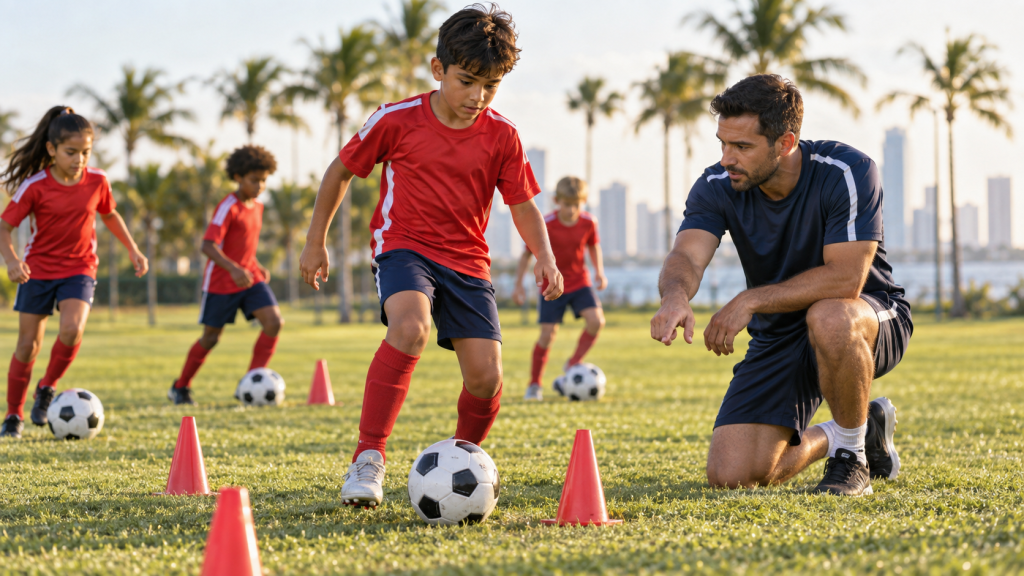
Developing strong soccer skills for young players requires more than simply playing games. Children need consistent training, clear guidance and opportunities to practice the fundamentals in an environment where they feel confident enough to try, make mistakes and improve.
Every player develops at a different pace, but certain technical, physical and mental abilities create the foundation for long-term progress. When these skills are introduced gradually and practiced regularly, young athletes become more comfortable with the ball and more capable of understanding the game.
Here are seven essential soccer skills every young player should develop.
Why Soccer Fundamentals Matter
Young players are often eager to score goals, compete and imitate their favorite professional athletes. Those ambitions are valuable, but progress begins with the fundamentals.
Ball control, passing, movement and decision-making influence almost every action during a match. A player who builds these foundations can perform with greater confidence as training becomes more advanced.
Fundamental training should remain age-appropriate. Younger children benefit from simple exercises, frequent touches and playful challenges. As they grow, those exercises can become faster, more precise and more closely connected to real game situations.
1. Ball Control and First Touch
Ball control is one of the most important soccer skills a young player can develop. A strong first touch allows a player to receive the ball and prepare the next action without losing possession.
Children should learn to control the ball using different parts of both feet. They can also practice receiving passes from multiple directions and at different speeds.
Useful ball-control activities include:
- Receiving and stopping the ball with the inside of the foot.
- Cushioning the ball instead of allowing it to bounce away.
- Controlling the ball while moving.
- Receiving with the right and left foot.
- Turning after the first touch.
A good first touch gives players additional time to observe the field, make decisions and execute their next movement.
2. Dribbling With Confidence
Dribbling allows players to move with the ball, escape pressure and create space. Young athletes should first become comfortable keeping the ball close before attempting complicated moves.
Exercises involving cones, changes of direction and different speeds can help develop coordination. Players should practice using the inside, outside and sole of both feet.
Effective dribbling is not about performing tricks during every possession. It involves recognizing when to carry the ball, when to change direction and when passing is the better option.
As confidence grows, players can practice dribbling while looking up rather than focusing only on the ball. This helps them recognize teammates, opponents and available space.
3. Accurate Passing
Soccer is a team sport, and passing connects every player on the field. A well-executed pass can maintain possession, move the team forward and create scoring opportunities.
Young players should learn to position their supporting foot correctly, strike the middle of the ball and follow through toward their target. Accuracy should come before power.
Training should include:
- Short passes with the inside of both feet.
- Passing while moving.
- Receiving before returning the ball.
- Passing to a teammate’s path rather than directly at their feet.
- Communicating before and after making a pass.
Passing exercises also teach timing, patience and cooperation. Players begin to understand that moving the ball effectively often produces better results than trying to do everything individually.
4. Shooting Technique
Scoring is one of the most exciting parts of soccer, but effective shooting depends on balance, body position and technique.
Young players should practice placing their supporting foot beside the ball, keeping their body controlled and making clean contact. They can gradually learn the differences between shooting for accuracy and striking with greater power.
It is also important to practice with both feet. A player may naturally prefer one side, but developing the weaker foot creates more options during a game.
Shooting exercises should include different angles and realistic situations instead of always placing the ball directly in front of the goal. Players can practice shooting after dribbling, receiving a pass or changing direction.
5. Movement, Balance and Coordination
Not every important soccer skill involves touching the ball. Players also need balance, coordination, agility and efficient movement.
These physical foundations help children accelerate, stop, turn, change direction and protect the ball while remaining under control. Activities such as short sprints, balance challenges, footwork patterns and movement through cones can support this development.
Movement training should match the child’s age and should not resemble an adult fitness program. The focus is developing body awareness and athletic confidence through safe, dynamic exercises.
Improved coordination can also help players perform technical skills more effectively because their bodies are better prepared to respond to changing situations.
6. Positioning and Decision-Making
A technically skilled player still needs to understand what is happening around them. Soccer constantly requires decisions: whether to pass, dribble, shoot, support a teammate or move into open space.
Young players can begin developing game awareness by learning to look up before receiving the ball. Coaches may also use small-sided activities that give every child more opportunities to participate and make decisions.
Players should gradually learn to:
- Recognize open space.
- Create passing options for teammates.
- Move after making a pass.
- Observe opponents before receiving the ball.
- Choose between passing, dribbling and shooting.
Mistakes are an essential part of this process. Players need opportunities to make decisions and understand the results rather than waiting for constant instructions from the sideline.
7. Communication and Teamwork
Soccer development extends beyond individual technique. Players need to communicate, cooperate and understand their responsibilities within a team.
Simple communication can include calling for the ball, warning a teammate about pressure and offering encouragement after a difficult play. Children should also learn to listen to coaches, respect teammates and respond positively to feedback.
Teamwork teaches young athletes that every role matters. A successful action may begin with a defender recovering the ball, continue with a midfielder making the right pass and finish with another player creating an opportunity.
These experiences help children develop confidence and social skills that can benefit them beyond the field.
Consistency Builds Stronger Players
Soccer skills are not developed in one practice. Progress comes through repetition, guidance and experiences that gradually become more challenging.
Consistent training helps players become familiar with movements and make better decisions under pressure. It also gives coaches an opportunity to observe progress and adapt exercises to each athlete’s stage of development.
Parents can support consistency by encouraging attendance, celebrating effort and understanding that development is rarely a straight line. Some skills improve quickly, while others require more patience.
How Parents Can Support Development
Parents play an important role, but support does not require coaching from the sideline. Children often benefit most when their families show interest, encourage effort and allow coaches to guide the technical process.
After training, parents can ask positive questions such as:
- What did you enjoy today?
- What new skill did you practice?
- What would you like to improve next time?
- How did you help one of your teammates?
These questions focus attention on learning and personal progress rather than only on goals, scores or results.
Families searching for an appropriate training environment can also review our guide on how to choose the right soccer program for kids in Miami.
Building Skills From the First Practice
The best time to begin developing strong foundations is from the child’s first experience with the game. Introductory training can help young athletes become comfortable moving, interacting with teammates and controlling the ball.
Atlético Fortaleza’s Mini Forta kids soccer program in Miami provides young beginners with an opportunity to start building coordination, confidence and a positive connection with soccer.
As players grow, training can become more technically and tactically demanding while continuing to reinforce the fundamentals.
Developing Complete Young Soccer Players
The essential soccer skills for young players include ball control, dribbling, passing, shooting, movement, decision-making and teamwork. These abilities work together and provide a foundation for continued development.
The objective is not to rush children toward perfection. It is to help them understand the game, build confidence and become more capable through consistent, age-appropriate training.
Would you like to find the Atlético Fortaleza program that matches your child’s age and experience?
Contact our team on WhatsApp to learn about current programs, locations and schedules, or book a trial so your child can experience our training environment on the field.
Ready to Help Your Child Build Stronger Soccer Skills?
Talk to our team to find the Atlético Fortaleza training program that matches your child’s age, experience and development goals, or book a trial to join us on the field.